

How to Mix and Match Jewelry for a Cohesive Look
Last Updated: November 4, 2026
Quick Summary
To mix and match jewelry, follow the 2:1:1 rule: choose two pieces in your dominant metal, one piece in a second metal, and one piece in a third finish or texture. This ratio gives the eye a clear leader, so the combination looks deliberate rather than accidental.
- The old gold-and-silver ban is outdated; what matters now is intentionality, repetition, and balance.
- For a clean silver look, layer two or three silver chains and add a single gold accent.
- Match metal to undertone: blue or purple veins suggest cool tones, green or olive veins suggest warm tones.
- Every good stack has an anchor, a filler, and one focal piece, with one focal piece per stack.
- Store mixed-metal pieces separately and wipe them with a soft dry cloth before storage.
Table of Contents
- Start with the Metal Mixing Rules That Actually Work
- How to Mix and Match Jewelry Silver for a Clean, Modern Look
- How to Mix and Match Jewelry Gold for Warm, Layered Style
- Wearing Gold Jewelry with a Silver Wedding Ring Without Clashing
- How to Figure Out What Jewelry Looks Best on You
- Layer Necklaces, Stack Rings, and Balance Proportions
- Keep Mixed Metals Looking New with Simple Maintenance
- Build Your Mixed-Metal Look at AmberShop
- Frequently Asked Questions
Start with the Metal Mixing Rules That Actually Work
Learning how to mix and match jewelry starts with one shift in thinking: metals are a color palette, not a set of rules. Many shoppers hold back from pairing gold with silver because of an old rule that no longer applies. Below, we break down the simple ratio that makes any combination look deliberate.
The 2:1:1 Rule Explained
The 2:1:1 rule keeps mixed metals from looking accidental. Pick two pieces in your dominant metal, then one piece in a second metal, then one piece in a third finish or texture.
- Two gold pieces: a chain necklace and hoop earrings
- One silver piece: a thin bangle
- One textured piece: a pearl or geometric accent
The ratio gives the eye a clear leader. Without a dominant metal, a stack reads as clutter instead of contrast.
Why the Old Gold-and-Silver Ban Is Outdated
The "never mix gold and silver" advice came from a time when jewelry was bought in matched sets. Modern styling treats metals the way it treats color: fashion styling guidance from The Cut shows how designers pair finishes freely on the runway.
What matters now is intentionality. A deliberate mix looks styled. A random mix looks unfinished. The difference is repetition and balance, not the metal itself.
The 2:1:1 rule gives any mixed-metal stack a clear leader instead of a random pile.
| Element | Count | Example piece |
|---|---|---|
| Dominant metal | Two pieces | Chain necklace and hoop earrings |
| Second metal | One piece | Thin silver bangle |
| Third finish or texture | One piece | Pearl or geometric accent |
How to Mix and Match Jewelry Silver for a Clean, Modern Look
Silver works best as the anchor of a minimalist look. To mix and match jewelry silver pieces, build a cool-toned base and add one warm accent for contrast.
Start with sterling silver as your dominant metal. Then:
- Layer two or three silver chains of different lengths
- Add a single gold ring or a gold-vermeil accent
- Keep gemstones clear or white to preserve the clean palette
A common mistake is adding too many finishes at once. One warm accent is enough. Two or three competing tones turn a modern stack into noise.
Silver also suits everyday wear well, and it reads crisp against denim, white cotton, and gray knitwear.
How to Mix and Match Jewelry Gold for Warm, Layered Style
Gold rewards layering. To mix and match jewelry gold pieces, vary the tone and texture rather than the metal family.
Yellow gold, rose gold, and gold vermeil all sit in the same warm family. Stack them together and the slight differences in tone create depth.
Try this combination:
- A yellow gold chain as the base
- A rose gold bracelet stacked beside it
- One sterling silver ring as the contrast piece
Watch out: plated and vermeil pieces wear at different rates. Mixing a heavily worn gold-plated chain with a fresh vermeil piece makes the older one look cheaper than it is.
Wearing Gold Jewelry with a Silver Wedding Ring Without Clashing
You can absolutely wear gold jewelry with a silver wedding ring. The trick is to treat the ring as a fixed anchor and build around it, not against it.
A white-gold or platinum wedding band is a cool-toned anchor. Pair it with:
- A gold ring on the opposite hand to balance the warmth
- Gold earrings or a gold chain near the face
- A mixed-metal bracelet that includes both tones
The ring never has to match. It has to be echoed. One gold piece elsewhere on the body makes the contrast look chosen rather than accidental.
If you want a versatile piece to bridge the two tones, a two-finish ring does the work for you. The Unique Men Women Dome Rings Stylish Unisex Jewelry come in gold and silver finishes, so you can choose your vibe or stack both.

How to Figure Out What Jewelry Looks Best on You
The fastest way to figure out what jewelry looks best on you is to match metal to your skin's undertone, then match scale to your frame. Neither test takes more than a minute, but each has a mechanism worth understanding so you can adapt when the quick test gives a murky answer.
Skin Tone and Metal Compatibility
Undertone is the hue beneath your skin's surface, and it is separate from surface color. A fair-skinned person can have warm undertones; a deep-skinned person can have cool undertones.
Check the veins on your inner wrist in natural light, not under a bathroom bulb.
Unique Men Women Dome Rings Stylish Unisex Jewelry →
- Blue or purple veins: cool undertone. Silver, platinum, white gold, and rhodium-finished pieces flatter most because their reflected light is cool.
- Green or olive veins: warm undertone. Yellow gold, rose gold, and bronze flatter most because their reflected light is warm.
- A mix of both, or veins that are hard to classify: neutral undertone. You can wear either family, so pick by outfit and mood.
Two edge cases trip people up. Olive skin often reads green-veined but looks best in high-contrast metals, bright yellow gold or bright silver, rather than muted rose gold. Deep skin with cool undertones often looks strongest in platinum and white gold, but yellow gold can read as a deliberate statement rather than a mismatch.
This is a starting point, not a limit. Plenty of warm-toned people wear silver daily and look great doing it.
Match Scale to Frame and Feature
Scale matters just as much as color. Delicate chains suit fine features and small frames. Bold cuffs and wide bands suit larger frames and stronger features.
A practical check: stand back from a mirror at arm's length. If you are unsure, the Fashion Jewelry Geometric Pearl Retro Jewelry Women bracelet is lightweight and comfortable for all-day wear.

Watch out: mixing a very fine chain with a very heavy cuff on the same wrist can make the fine piece look like an afterthought rather than a contrast.
Layer Necklaces, Stack Rings, and Balance Proportions
Layering and stacking are the same skill applied to different body parts: you are building a small composition with a clear top, middle, and bottom.
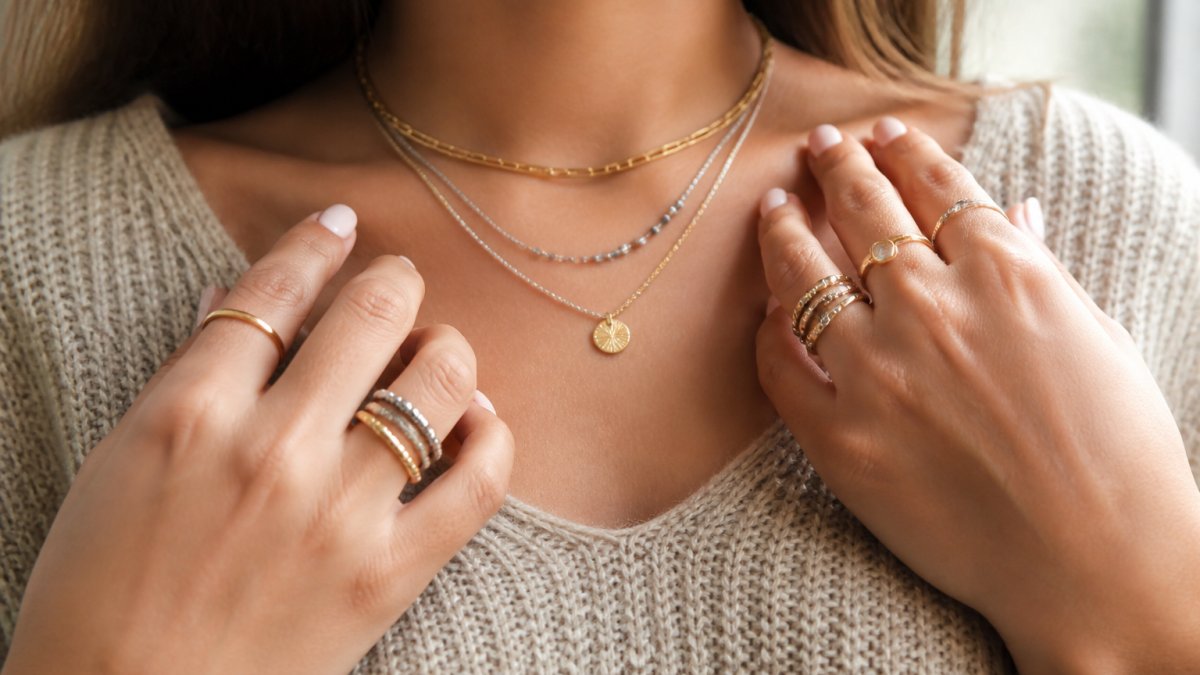
The Visual Anatomy of a Stack
Every good stack has three parts.
- Anchor: the heaviest or most meaningful piece, worn closest to the body
- Filler: lighter pieces that add texture and length
- Focal piece: the one statement item that draws the eye
For necklaces, put the anchor at the shortest length and let fillers drop below it. For rings, anchor with a bold band on the index finger and fill with thin bands on the ring and pinky fingers.
Keep one focal piece per stack. Two statement pieces on the same wrist or hand fight each other.
If you want a head start, the Jewelry Fashion Necklace Earrings Bracelet Ring Four Piece Jewelry Set includes a necklace, earrings, bracelet, and ring in one coordinated set. For necklace layering, the Fashion All-match Jewelry Ornament 10 Pieces Women's Necklace Suit includes ten necklaces in one set.

Keep Mixed Metals Looking New with Simple Maintenance
Mixed-metal jewelry ages at different rates, and the reason is physical, not cosmetic. Understanding how metals interact with each other and with your skin is the difference between a stack that stays sharp for years and one that looks tired in months.
Why Mixed Metals Age Differently
Three mechanisms drive most mixed-metal wear:
- Abrasion between hardness levels. Sterling silver and gold are relatively soft; platinum and stainless steel are harder. When a hard piece rubs against a soft one in a shared box or on the same wrist, the soft piece loses material first. A platinum band stacked against a sterling silver ring will slowly wear a flat spot into the silver.
- Galvanic interaction. When two different metals touch in the presence of moisture and salts from skin, a small electrical current can flow between them. In jewelry this shows up as faster tarnish on the less noble metal, usually silver next to gold, and occasionally as pitting on plated pieces.
- Tarnish transfer. Silver tarnish is sulfur-based and can transfer to adjacent pieces in storage, especially in humid conditions. A tarnished silver chain stored against a gold chain can leave a dark film on the gold.
None of this means you should avoid mixing. It means storage and wear rotation matter more than most guides admit.
A Maintenance Routine Built for Mixed Stacks
- Store pieces separately, or line the box. Plated and vermeil items rub against harder metals and wear faster in a shared box. If you use one tray, keep each piece in its own small pouch or compartment.
- Put jewelry on last. Perfume, lotion, and hairspray dull finishes over time. Let products dry fully before putting on rings and bracelets.
- Wipe after wear. A soft dry cloth removes skin oils and salts before they set. Do this before storage, not the next morning.
Know What You Own
Material labels matter when you are deciding how a piece should be worn. Know whether a piece is solid, plated, or vermeil before you build a daily-wear stack around it.
Watch out: storing a tarnished silver piece against a gold piece is the fastest way to transfer a dark film onto the gold. Clean silver before it goes back in the box, not after you notice the gold looks dull.
Build Your Mixed-Metal Look at AmberShop
Start with one rule, one anchor piece, and one contrast piece. That is the whole method.
At AmberShop21, we curate jewelry for everyday wear, not just special occasions. Our pieces are chosen to mix across metals and finishes, so a single purchase works with what you already own.
Ready to build your stack? View all and find the anchor piece that ties your look together.
Frequently Asked Questions
What is the 2:1:1 rule in jewelry?
The 2:1:1 rule is a simple proportion guide for mixing metals. It means wearing two pieces of one metal, one piece of a second metal, and one piece that combines both. For example, two gold necklaces, one silver bracelet, and a two-tone ring. The ratio keeps the look intentional rather than evenly split, which can feel visually flat. It works for any metal pairing, including gold with silver or rose gold with platinum.
Why do people say not to mix gold and silver?
The old advice came from formal jewelry traditions where matched sets signaled polish. Modern styling treats mixed metals as a deliberate contrast rather than a mistake. The key is intentionality: pick one metal as the dominant tone and let the other act as an accent. When you mix and match jewelry this way, gold and silver read as a coordinated choice instead of an accident.
Can you wear gold jewelry with a silver wedding ring?
Yes. A silver wedding ring pairs well with gold pieces when you create a visual bridge. Try a two-tone band, a ring with both finishes, or place the wedding ring between gold bands so it reads as part of a stack. Keep the dominant metal consistent across your other jewelry, and let the wedding ring stay the focal piece on that hand.
How do you figure out what jewelry looks best on you?
Start with your undertone. Cool undertones tend to suit silver, platinum, and white gold, while warm undertones often flatter gold and rose gold. Then consider scale: delicate pieces suit fine features and minimalist aesthetics, while bold dome rings and statement pieces add contrast for maximalist looks. Try a few finishes in natural light and notice which ones make your skin look brighter.
Mixing metals is a skill, not a rulebook. Pick your dominant tone, add one deliberate contrast, and let your stack evolve as your style does. AmberShop21 makes that easy with affordable, curated pieces designed to layer, stack, and wear daily. Get started with AmberShop21 and build a look that feels like you.


