

How to Clean Gold Plated Jewelry: A Safe 2026 Guide
Last Updated: October 23, 2026
Quick Summary
To clean gold plated jewelry, soak it for three to five minutes in lukewarm distilled water with a drop or two of mild dish soap, then brush gently with a soft-bristled brush, rinse with clean distilled water, and buff completely dry with a microfiber cloth. Never use hot water, abrasive pastes, or ultrasonic cleaners, and do not air dry.
- Tarnish is usually a base-metal problem, not a gold problem, so protect the plating to protect the shine.
- Skip baking soda, toothpaste, rough sponges, chlorine, bleach, and ammonia-based cleaners on plated pieces.
- Never soak plated jewelry overnight or use hot water, since prolonged moisture seeps under the plating.
- Do not shower or swim in gold-plated jewelry; put jewelry on last and take it off first.
- Store each piece in its own airtight pouch with a silica packet, away from bathrooms and kitchens.
Table of Contents
- Why Gold Plated Jewelry Tarnishes (and What Actually Causes It)
- What You'll Need Before You Start Cleaning
- How to Clean Gold Plated Jewelry: Step-by-Step
- The Best Cleaner for Gold-Plated Jewelry (and What to Avoid)
- How to Clean Tarnished Gold-Plated Jewelry Without Stripping the Plating
- How to Store Gold-Plated Jewelry So It Stays Bright
- Can You Shower With Gold-Plated Jewelry? What Water Does to Plating
- Gemstone-Specific Cleaning and Repairing Worn Plating
- Frequently Asked Questions
Why Gold Plated Jewelry Tarnishes (and What Actually Causes It)
Gold plated jewelry tarnishes because the thin gold layer sits on a base metal that reacts with air, moisture, and oils. When the gold wears thin, the metal underneath oxidizes into a dull, dark, or greenish film.

Here is what most care guides skip: the gold itself rarely tarnishes.
So what speeds up the damage?
- Moisture: Water and humidity get into tiny pores and start corrosion on the base metal.
- Chemicals: Perfume, lotion, hairspray, and sunscreen all react with the plating.
- Friction: Rubbing against skin or other jewelry thins the gold layer over time.
At AmberShop21, we tell customers to think of gold plating like a good coat of paint: it protects what is underneath but needs care to last.
What You'll Need Before You Start Cleaning
Gather the right tools first, the wrong supplies are the fastest way to strip plating.
- Mild dish soap: A few drops of a gentle, non-toxic formula with no harsh detergents.
- Distilled water: Tap water can leave mineral residue and may contain chemicals that react with the metal.
- A soft-bristled brush: A baby toothbrush or a soft makeup brush works well.
Skip anything abrasive, baking soda paste, toothpaste, rough sponges, since these scratch the gold layer and speed up wear. Avoid ultrasonic cleaners unless a jeweler confirms your piece can handle one; vibrations loosen stones and wear thin plating.
A quick note on cloths: paper towels and tissues can feel soft, but their fibers are rougher than they look. Stick with microfiber.
How to Clean Gold Plated Jewelry: Step-by-Step
This safe routine takes about five minutes with supplies you likely already have. Follow the steps in order and do not rush the drying stage.
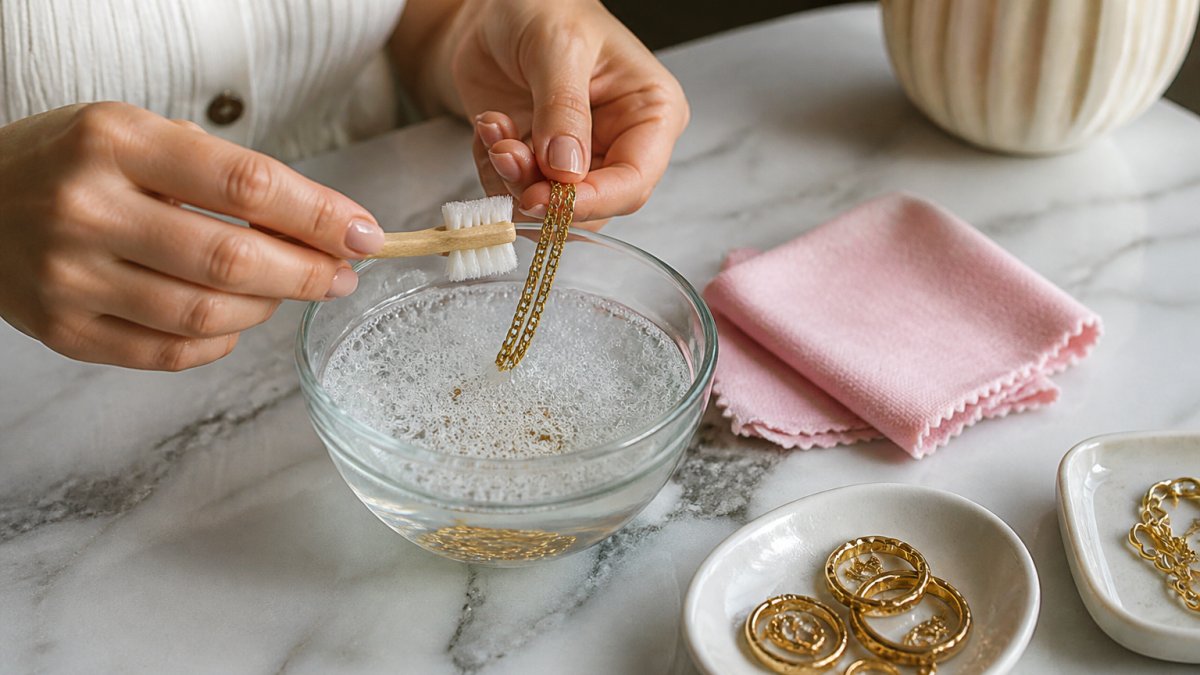
Step 1: Prep Your Workspace and Inspect the Piece
Lay a soft towel on a flat surface so nothing rolls or drops. Check for loose stones, bent prongs, or worn spots. If bare base metal shows through, cleaning will not fix that and scrubbing makes it worse, set those pieces aside for a jeweler.
Step 2: Soak in Mild Dish Soap and Distilled Water
Fill a small bowl with lukewarm distilled water and add a drop or two of mild dish soap. Soak for three to five minutes, long enough to loosen grime, short enough to avoid prolonged moisture. Never use hot water, which can damage stones and adhesives.
Step 3: Brush Gently, Rinse, and Buff Dry
Lift the piece out and brush softly around stones and into crevices. Rinse with clean distilled water, then dry completely with a microfiber cloth, buffing lightly to restore shine. Do not air dry, leftover moisture invites corrosion.
| Step | What You Do | Time | Watch Out For |
|---|---|---|---|
| 1. Prep and inspect | Lay towel, check for wear | 1 min | Bare metal, loose stones |
| 2. Soak | Mild soap + distilled water | 3-5 min | Hot water, long soaks |
| 3. Brush, rinse, buff | Soft brush, then microfiber | 2 min | Air drying, rough cloths |
The Best Cleaner for Gold-Plated Jewelry (and What to Avoid)
The best cleaner for gold-plated jewelry is mild dish soap mixed with distilled water. It lifts oils and grime without attacking the plating. You do not need a store-bought polish, and many commercial cleaners are too harsh for thin gold layers.
What to avoid, plain and simple:
- Abrasive polishes and pastes: They scratch the gold and wear it thinner.
- Baking soda or toothpaste: Both are mildly abrasive and can dull the finish.
- Chlorine and bleach: These corrode base metals fast. Take jewelry off before cleaning with them.
If a piece is heavily tarnished, do not reach for a stronger product. A gentle clean followed by proper storage does more good than any aggressive scrub.
How to Clean Tarnished Gold-Plated Jewelry Without Stripping the Plating
When tarnish has set in, the goal shifts from cleaning to protecting what is left.
Start with the same mild soap and distilled water soak.
Here is the hard truth: once tarnish has eaten into the base metal, no cleaner brings the gold back.
If a piece looks dull but not damaged, a light microfiber buff often restores shine without water.
Fashion 18K Gold Plated Jewelry Set →
How to Store Gold-Plated Jewelry So It Stays Bright
How you store gold-plated jewelry matters as much as how you clean it.
Tarnish on the base metal is driven largely by sulfur compounds and oxygen in the air, plus humidity that carries them to the surface.
Follow these storage habits:
- Keep it dry: Store jewelry away from bathrooms and kitchens, where steam and humidity live. A bedroom drawer beats a vanity next to the sink.
- Go air-tight: A small zip pouch or a lined jewelry box limits exposure to air and moisture. Press the air out of zip bags before sealing.
- Separate pieces: Store each item in its own pouch or compartment so they do not scratch each other. Friction between pieces is one of the fastest ways to thin plating.
Lay necklaces flat or hang them to avoid kinks, and fasten clasps so chains do not tangle.
One trade-off: anti-tarnish strips and silica packets work best in a closed, small volume, a large open box with a single strip does little.
Can You Shower With Gold-Plated Jewelry? What Water Does to Plating
Short answer: no, you should not shower with gold-plated jewelry. Water, soap, and shampoo all wear down the plating over time.
Water gets into microscopic pores in the plating and reaches the base metal; once moisture is trapped there, oxidation begins.
The same logic applies to swimming. Chlorine in pools and salt in the ocean both corrode base metals quickly.
Gemstone-Specific Cleaning and Repairing Worn Plating
Not every piece can be cleaned the same way. Gemstones vary in hardness and reaction to water and soap, and plated pieces often use glued settings that add a second risk.
- Hard stones (diamond, sapphire, ruby): Generally fine with mild soap and a soft brush. These stones tolerate water and gentle agitation well, but the plating around them still needs the same light touch.
- Porous stones (opal, pearl, turquoise): Keep them out of water. These stones can absorb moisture and change appearance, and pearls in particular are soft and easily scratched. Wipe with a barely damp cloth and dry right away.
- Glued settings: Avoid soaking, and avoid heat. Water and warmth can soften or weaken the adhesive that holds a stone in place, and a stone that loosens during cleaning is a repair bill you did not plan for. Clean the metal around the stone with a damp cloth and leave the stone itself alone.
When in doubt, clean the metal around a stone with a damp cloth and leave the stone itself alone. For pearls especially, skip the soak entirely.
Tarnish vs. Worn Plating: How to Tell the Difference
Most cleaning guides blur this distinction, and it changes what you should do. Tarnish is a surface film on the base metal, usually dark, dull, or greenish, that gentle cleaning can often reduce.
A simple test: clean a small, hidden area with mild soap and a soft cloth. If the dullness lifts and the color evens out, you were looking at tarnish.
Repairing Worn Plating
As for repairing worn plating, you cannot restore it at home. Once the gold layer is gone, only a jeweler can re-plate the piece through electroplating, stripping the old surface, preparing the base metal, and applying a new gold layer, with cost and feasibility depending on the piece.
That is also why we build our collection around accessible, easy-to-wear pieces at AmberShop21. Our Fashion 18K Gold Plated Jewelry Set at $22.62 gives you a full matching look without the worry of a luxury price tag, and it is easy to care for with the routine above. If you like options, the Fashion Necklace Bracelet Earrings Ring Jewelry Set at $22.62 and the 10-Piece Women's Necklace Set at $22.28 let you rotate pieces so each one lasts longer.


For more on caring for plated metals and gemstones, the Gemological Institute of America's gemstone care guides are a solid reference, and the Federal Trade Commission's guidance on jewelry marketing claims explains what "gold plated" actually means. The American Gem Society's jewelry care resources also cover stone-specific cleaning in more depth.
Frequently Asked Questions
Can you use baking soda to clean gold-plated jewelry?
Skip it. Baking soda is a mild abrasive, and on gold-plated pieces it can scratch the thin gold layer and wear down the plating faster with every scrub. The same goes for toothpaste, which contains abrasives that dull the finish. For everyday cleaning, mild dish soap and distilled water are safer for gold plated jewelry. Save baking soda for solid gold or stainless steel pieces that can handle more friction.
How often should you clean gold-plated jewelry?
Clean your gold-plated pieces every two to four weeks with mild dish soap and water, and give them a quick wipe with a microfiber cloth after each wear. If you wear a piece daily, a weekly wipe-down keeps oils, lotion, and perfume from building up and speeding up tarnish. Deep cleaning more than once a month is rarely needed and can wear down the plating over time.
How do you make gold-plated jewelry look gold again after tarnish?
Start with a gentle wash using mild dish soap and distilled water, then buff dry with a microfiber cloth. If the shine is still dull, a soft polishing cloth made for plated jewelry can restore some luster. Once the plating has worn through to the base metal, no cleaner will bring the gold back. At that point, a jeweler can re-plate the piece, or you can replace it with a fresh set like the Fashion 18K Gold Plated Jewelry Set ($22.62) from AmberShop.
What is the best cleaner for gold-plated jewelry?
A mix of a few drops of mild dish soap in warm distilled water is the safest option for most gold-plated pieces. Avoid ultrasonic cleaners, ammonia-based jewelry dips, and abrasive polishes, since they can strip or scratch the plating. For pieces with gemstones, check whether the stone can handle water before soaking. When in doubt, a soft-bristled brush and a microfiber cloth with plain water will handle most light cleaning.
Caring for plated jewelry takes a few minutes a week, but the payoff is shine that lasts far longer than a rushed scrub ever delivers. At AmberShop21, we make beautiful, accessible jewelry for everyday wear, and we want each piece to keep its glow. Explore our curated jewelry collection, with sets that let you rotate and protect your favorites, and find your next everyday sparkle. Get started with AmberShop21 and keep your pieces looking their best.


