

7 Ways to Tell If Jewelry Is High Quality
Last Updated: November 7, 2026
Quick Summary
High quality jewelry is built from solid precious metal, set with securely mounted stones, and finished so it holds up to daily wear. Check the purity stamp, feel the weight, examine the finish, test with a magnet, and wiggle the stones to confirm a piece is solid rather than plated.
- Solid gold is gold all the way through, while gold plated pieces have a thin layer that wears off.
- Real gold carries a karat stamp and real silver carries a fineness stamp such as 925.
- 18K gold is softer than 14K, so it marks more easily with everyday wear.
- Bezel settings wrap the stone in metal and are the most forgiving for daily wear.
- Plated costume jewelry cannot be restored once the coating wears through.
Table of Contents
- What Separates High Quality Jewelry From Costume Pieces
- How to Tell If Jewelry Is High Quality at Home
- How to Tell If Jewelry Is Real Gold or Silver
- 14K vs. 18K Gold Quality: Which One Holds Up Better
- Gemstone Quality and Stone Setting Security
- Prongs, Clasps, and Soldering: Reading the Craftsmanship
- The Full Inspection Checklist: Durability and Repairability
- Shop Pieces You Can Inspect With Confidence
- Frequently Asked Questions
What Separates High Quality Jewelry From Costume Pieces
High quality jewelry is a piece built from solid precious metal, set with securely mounted stones, and finished so it holds up to daily wear. Costume pieces use base metal with a thin plating that wears away.
The difference shows up over months, not minutes. A plated ring looks identical to a solid one on day one. By month six, one still shines and the other has gone dull, green, or patchy.
Shoppers often judge a piece by how it looks in the first photo. That is the worst possible test.
So here is how to tell if jewelry is high quality before you buy, and what to check the moment it arrives.
Solid, Plated, Vermeil, and Filled: Know the Difference
These four terms get used loosely, and the gap between them is huge.
- Solid gold: gold all the way through. A 14K solid ring is 14K metal from surface to core.
- Gold plated: a base metal core with a thin gold layer on top. The layer wears off.
- Vermeil: sterling silver core with a thicker gold layer. Better than plating, still a coating.
- Gold filled: a thick layer of gold bonded to base metal. Far more durable than plating, but not solid.
Base metal is the giveaway word. If a listing says "gold tone," "gold fashion," or names no metal at all, you are looking at plating.
How to Tell If Jewelry Is High Quality at Home
You can spot most quality problems at home with your eyes, your hands, and a magnet. Start with the stamp, then check weight, finish, and how the stones sit.
Here is the order that works best:
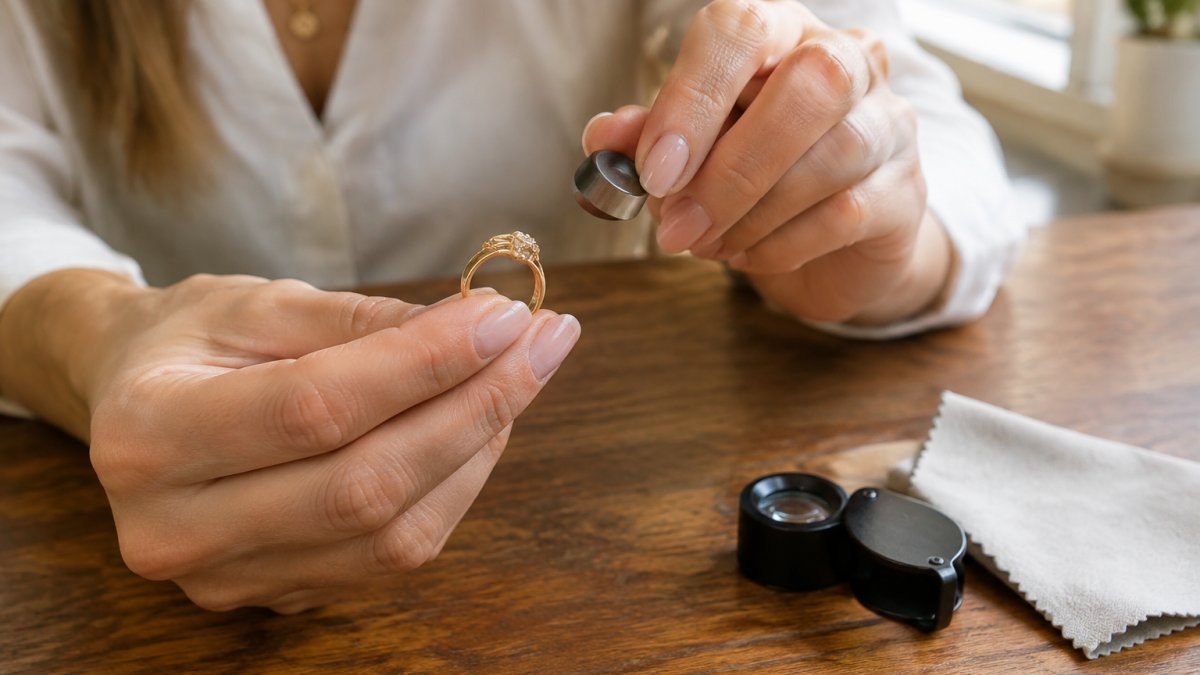
- Find the stamp. Look inside the band or on the clasp tag with a loupe.
- Weigh it in your hand. Solid metal feels denser than plated base metal of the same size.
- Check the finish. Run a fingernail over the surface. Bumps and thin spots mean uneven plating.
- Test with a magnet. Strong pull usually means a base metal core.
- Wiggle the stones. Any movement means a loose setting.
The Limits and Safety of At-Home Tests
Home tests give you clues, not proof. A magnet will not attract gold or silver, but plenty of base metals are non-magnetic too. So a magnet that grabs tells you a lot; one that does not tells you less.
Skip the acid test on finished pieces. It can mark the surface, and it is easy to get wrong. The Federal Trade Commission's jewelry guides set the labeling rules sellers must follow, which is why the stamp matters more than any kitchen experiment.
For a real answer on a valuable piece, get a professional appraisal. A jeweler can confirm metal purity and stone quality in minutes.
Run through these five checks in order the moment a piece arrives.
| Step | What to do | What it reveals |
|---|---|---|
| Find the stamp | Look inside the band or on the clasp tag with a loupe | Purity claim |
| Weigh it in your hand | Compare feel against a known piece of the same size | Solid metal feels denser than plated base metal |
| Check the finish | Run a fingernail over the surface | Bumps and thin spots mean uneven plating |
| Test with a magnet | Hold a magnet to the piece | Strong pull usually means a base metal core |
| Wiggle the stones | Gently move each stone | Any movement means a loose setting |
How to Tell If Jewelry Is Real Gold or Silver
Real gold carries a karat stamp and real silver carries a fineness stamp. No stamp, or a vague one, is your first warning sign.
Gold karat tells you the purity level. Fineness does the same job for silver, and 925 means 92.5 percent silver, which is the standard for sterling silver (Buying Platinum, Gold, and Silver Jewelry).
Look for these hallmarks and quality stamps:
- 24K, 18K, 14K, 10K for gold
- 925, 958, 999 for silver
- A maker's mark stamp beside the purity mark
A 925 stamp on a ring is a good sign, but it is only a claim. Pair it with the weight test and a close look at the finish. You can see how a stamped sterling piece is listed on this 925 sterling silver fashion ring for women.

14K vs. 18K Gold Quality: Which One Holds Up Better
18K gold is softer and richer in color than 14K, which makes it easier to mark for everyday wear.
That trade-off is the whole story. Higher gold karat means more pure gold and less metal alloy, which means a softer piece.
Gemstone Quality and Stone Setting Security
A secure setting matters more than stone size.
Gemstone quality is commonly judged by color, clarity, cut, and carat weight.
Then check the setting type:
- Prong settings show more stone but snag on knitwear.
- Bezel settings wrap the stone in metal, which protects it.
- Pave settings look delicate and lose tiny stones easily.
A palm pendant with a set stone, like this amethyst palm pendant necklace, shows a stone set in a shaped pendant.
Prongs, Clasps, and Soldering: Reading the Craftsmanship
Jewelry craftsmanship lives in the joins. Open a clasp and look at the hinge. Run a finger along the inside of a band. The places nobody photographs are the places that fail first.
Check these three spots:
- Prongs: all tips present, even height, no flat worn edges.
- Clasp: snaps firmly, spring returns, no side-to-side play.
- Soldering: smooth seams, no dark pits, no lumpy blobs where parts meet.
Links should move freely without gaps. A finish that catches light evenly across the whole piece points to real polishing work, not a quick buff.
A multi-ring design shows those joins in plain view, which is why a three-ring interlocking ring is a good piece to practice your eye on.

The Full Inspection Checklist: Durability and Repairability
Durability comes from construction. A heavy, well-soldered piece is generally more resistant to knocks than a light, glued one. The checklist below is built to answer two questions at once: will this piece hold up, and can it be fixed when it does not?
Inspection checklist, in the order that catches the most problems:
- Purity stamp present, readable, and consistent with the listed metal
- Maker's mark beside the stamp
- Even weight for the size, compare against a known piece in the same hand
- Smooth finish with no thin, bubbled, or patchy plating at wear points
- Stones tight, level, and evenly set, with all prong tips present
- Clasp snaps firmly, spring returns, no side-to-side play
- Seams smooth and fully soldered, with no dark pits or lumpy blobs
- Links move freely without gaps or stiff joints
- No sharp edges against the skin
How construction choices drive longevity:
- Metal choice. 18K gold is softer than 14K and shows wear sooner on a daily ring. Sterling silver tarnishes, which is a maintenance issue rather than a structural one. Tungsten carbide is described as scratch-resistant.
- Setting security. Bezel settings protect a stone with a metal rim and are the most forgiving for daily wear. Prong settings show more stone but snag on knitwear and lose tips over time. Pave settings look delicate and shed tiny stones, so they need periodic tightening.
- Join quality. Soldered seams that are smooth and fully filled outlast seams that are spot-soldered or glued. On chains, look for soldered links at the clasp ends; open links there are the first thing to fail.
- Hollow vs. solid construction. Hollow rings and bangles feel light for their size and dent more easily, and many cannot be resized. Solid pieces cost more in metal but survive resizing and repair.
Repairability, in practical terms:
Plated costume jewelry and imitation jewelry cannot be restored once the coating wears through, because there is no metal underneath to restore.
Tarnish vs. plating wear, a distinction that matters:
Tarnish and discoloration are not always a defect. Silver darkens with air and skin oils, and a polishing cloth brings it back. Plating wear is different: once the layer thins, no polish fixes it.
Watch out: buying a plated piece and wearing it daily against lotion, perfume, and water is the fastest way to kill the finish, save plated pieces for occasional wear and keep them dry.
This dome ring in tungsten carbide is built for everyday wear, with a scratch-resistant finish and sizes 6 to 13.

Shop Pieces You Can Inspect With Confidence
Many quality problems are visible before you pay if you know where to look. Check the stamp, feel the weight, and look at the joins and clasp.
AmberShop21 lists the metal for the pieces in its collection, including 925 sterling silver and tungsten carbide. The collection is designed for everyday wear.
Start with one piece, inspect it properly, and let that tell you whether the rest of the collection earns your trust. Jewelry materials guidance from the Gemological Institute of America is a solid next read if you want to go deeper on metals and stones.
Browse the AmberShop21 collection to find pieces for everyday wear.
Quality jewelry rewards a closer look. Pick one piece from our collection, run the checklist above when it lands, and see the difference for yourself.
Frequently Asked Questions
Can gold be fake if it is stamped 14K?
Yes. A stamp is only a claim, and counterfeiters copy hallmarks onto plated or base metal pieces. Treat the stamp as a starting point, not proof. Check that the mark is crisp and consistent with the piece's style, look for wear that exposes a different color underneath, and confirm weight and feel. For anything expensive, a professional appraisal can help verify the metal.
How can you tell if jewelry is real silver?
Look for a 925 stamp, which means 92.5 percent sterling silver, along with a maker's mark. Real sterling tarnishes to a dark gray or black film that polishes off, while plated pieces often show copper or brass color at worn edges. Silver is not magnetic, so a magnet should not stick. A soft, high-pitched ring when tapped lightly also points to solid metal, though these at-home checks confirm clues rather than guarantee authenticity.
Is 14K or 18K better quality?
Neither is automatically better. 18K is softer than 14K and can look richer in color, which can matter for daily-wear rings. Choose 18K for occasional pieces and settings that need a softer metal, and 14K for rings and bracelets that take daily handling.
When should you have jewelry professionally evaluated?
Get an appraisal when a piece is expensive, inherited, or sold as a specific metal or stone, and before relying on any at-home test result. A jeweler can confirm metal purity with an acid test or electronic tester, grade gemstones, and check whether prongs and clasps are secure. Ask for the evaluation in writing if you plan to insure the piece or resell it later.


